INTRODUCTION
The web has changed dramatically over the past few decades. Websites have evolved from simple collections of text and images into highly interactive platforms that support e-commerce, communication, entertainment, education, healthcare, finance, and business operations.
But what will websites look like in 2030?
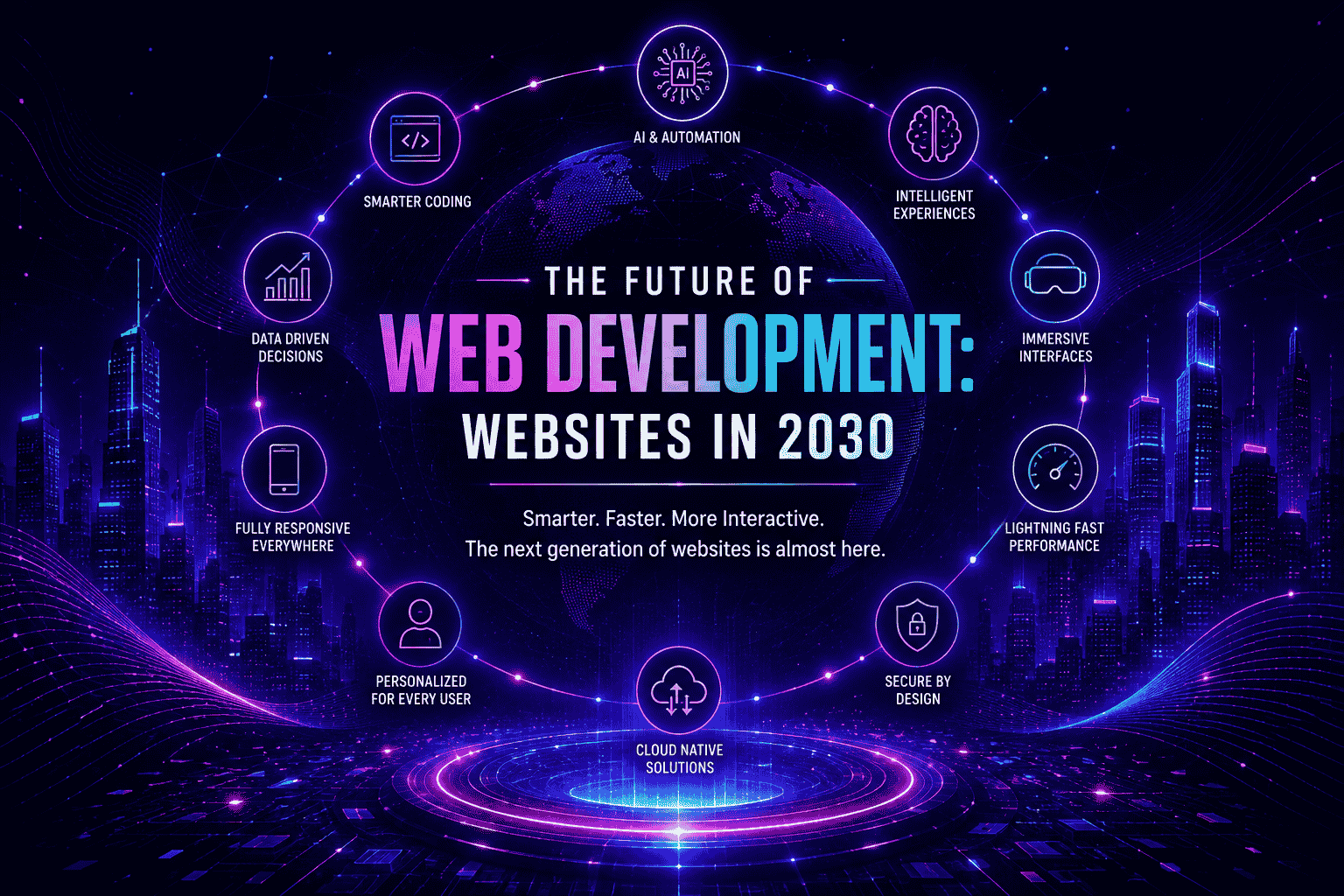
The next generation of web development is likely to be shaped by artificial intelligence, automation, personalization, faster technologies, immersive experiences, and smarter interactions. Websites may no longer behave like static pages that users simply visit. Instead, they could become intelligent digital experiences that understand users, respond to their needs, and adapt in real time.
For businesses, this transformation will create new opportunities to improve customer experiences, automate processes, and build stronger digital products.
1. AI WILL BECOME PART OF WEB DEVELOPMENT
Artificial intelligence is already changing the way websites and applications are developed. Developers can use AI tools to generate code, identify errors, create content, analyze data, and speed up repetitive development tasks.
By 2030, AI is expected to become even more deeply integrated into the development workflow.
Developers may be able to describe a feature in natural language and use AI-assisted development tools to generate much of the initial implementation. However, human developers will continue to play an important role in architecture, security, performance, user experience, testing, and business logic.
The future is therefore unlikely to be simply “AI replacing developers.” Instead, it will be about developers working alongside intelligent tools to build better software faster.
2. WEBSITES WILL BECOME MORE PERSONALIZED
Today's websites often provide the same experience to every visitor. In the future, websites could become much more personalized.
AI and data-driven systems can help websites understand user behavior and provide more relevant experiences. Content, product recommendations, navigation, and communication could adapt based on a user's needs and interactions.
For example, an e-commerce website could display products based on previous interactions, while a business website could present different services depending on the visitor's interests.
Personalization could make websites feel less like digital brochures and more like intelligent digital assistants.
3. CONVERSATIONAL WEBSITES WILL BECOME COMMON
Traditional navigation may not always be the fastest way for users to find information. Instead of searching through multiple pages, users may simply ask a website what they need.
AI-powered conversational interfaces could allow visitors to ask questions such as:
• Which service is best for my business?
• Can I get a quotation?
• Where can I find this product?
• Can you explain this service?
• How can I contact your team?
The website could understand the request, provide relevant information, and guide the user toward the next action.
4. WEBSITES WILL BECOME MORE INTERACTIVE
The websites of 2030 are likely to provide much richer interactions than today's standard layouts.
Advanced animations, 3D elements, interactive visualizations, voice interfaces, and immersive experiences could become more common as browser capabilities and hardware continue to improve.
However, good web design will still require balance. Interactive elements should improve the user experience rather than simply make a website look impressive.
5. PERFORMANCE WILL REMAIN CRITICAL
As websites become more intelligent and interactive, performance will become even more important.
Users expect websites to load quickly and work smoothly across smartphones, tablets, laptops, and other connected devices. Developers will need to focus on optimized code, efficient assets, responsive design, caching, modern browser technologies, and scalable infrastructure.
A visually impressive website will not succeed if users have to wait for it to load.
6. RESPONSIVE DESIGN WILL EVOLVE
Responsive design has already become a fundamental part of modern web development. By 2030, websites may need to adapt to an even wider range of devices and interfaces.
Instead of designing only for desktop and mobile screens, developers may need to consider smart displays, wearable devices, voice-controlled interfaces, automotive systems, and other connected environments.
The goal will be to create digital experiences that work naturally across different devices.
7. BACKEND SYSTEMS WILL BECOME MORE INTELLIGENT
The future of web development is not only about what users see on the screen. Backend systems will also continue to evolve.
Modern applications require reliable APIs, databases, authentication systems, cloud infrastructure, security, analytics, and automation. As applications become more complex, scalable backend architecture will become increasingly important.
Businesses will need backend systems that can handle growing amounts of users, transactions, and data while maintaining reliability and security.
8. CLOUD AND SERVERLESS TECHNOLOGIES WILL CONTINUE TO GROW
Cloud computing has already changed the way applications are developed and deployed. Businesses can use cloud infrastructure to scale applications, store data, deploy services, and support users across different locations.
Serverless technologies and managed cloud services can also reduce the amount of infrastructure developers need to manage directly.
By 2030, web development is likely to become even more closely connected with cloud platforms and automated deployment systems.
9. CYBERSECURITY WILL BECOME EVEN MORE IMPORTANT
More intelligent websites will also create new security challenges.
Web applications handle sensitive information such as customer details, account credentials, payment information, and business data. Developers will need to prioritize secure authentication, authorization, encryption, secure APIs, data protection, and continuous security monitoring.
Security should not be treated as something added at the end of development. It needs to be considered throughout the entire software development lifecycle.
10. WEB DEVELOPMENT WILL BECOME MORE ACCESSIBLE
AI-assisted development and modern development platforms could make it easier for individuals and businesses to create digital products.
People without extensive programming experience may be able to create prototypes, landing pages, internal tools, and simple applications using AI-assisted and low-code technologies.
At the same time, professional developers will remain essential for complex systems that require advanced architecture, integrations, security, scalability, and custom business logic.
WHAT DOES THIS MEAN FOR BUSINESSES?
The future of web development is not simply about having a more attractive website. Businesses will need digital platforms that provide measurable value.
A modern business website may need to:
• Communicate with customers intelligently
• Provide personalized experiences
• Automate repetitive processes
• Integrate with business systems
• Work across multiple devices
• Protect customer information
• Load quickly and perform reliably
• Scale as the business grows
This means businesses should think of their website as a digital product rather than simply an online brochure.
THE ROLE OF DEVELOPERS IN 2030
As development tools become more intelligent, the role of developers will continue to evolve.
Developers will increasingly focus on solving problems, designing software architecture, understanding business requirements, managing data, ensuring security, improving performance, and creating meaningful user experiences.
Programming knowledge will remain valuable, but developers will also need to understand AI tools, cloud technologies, APIs, cybersecurity, databases, user experience, and modern software architecture.
PREPARING FOR THE FUTURE TODAY
Businesses and developers do not have to wait until 2030 to prepare for these changes.
Businesses can start by investing in responsive websites, modern software architecture, secure infrastructure, automation, analytics, and AI-powered solutions where they provide genuine value.
Developers can prepare by continuously learning modern frontend and backend technologies, cloud platforms, AI-assisted development tools, APIs, databases, cybersecurity practices, and emerging web standards.
CONCLUSION
The website of 2030 may look very different from the websites we use today. AI, personalization, conversational interfaces, automation, cloud computing, immersive experiences, and advanced backend systems will continue to shape the future of the web.
But one principle will remain important:
Technology should solve real problems.
The most successful websites will not necessarily be the ones with the most features. They will be the ones that provide fast, secure, accessible, intelligent, and meaningful experiences for their users.
At Cronusgen Technologies, we believe the future of web development is about combining technology, creativity, and practical business solutions to build digital experiences that are ready for what comes next.