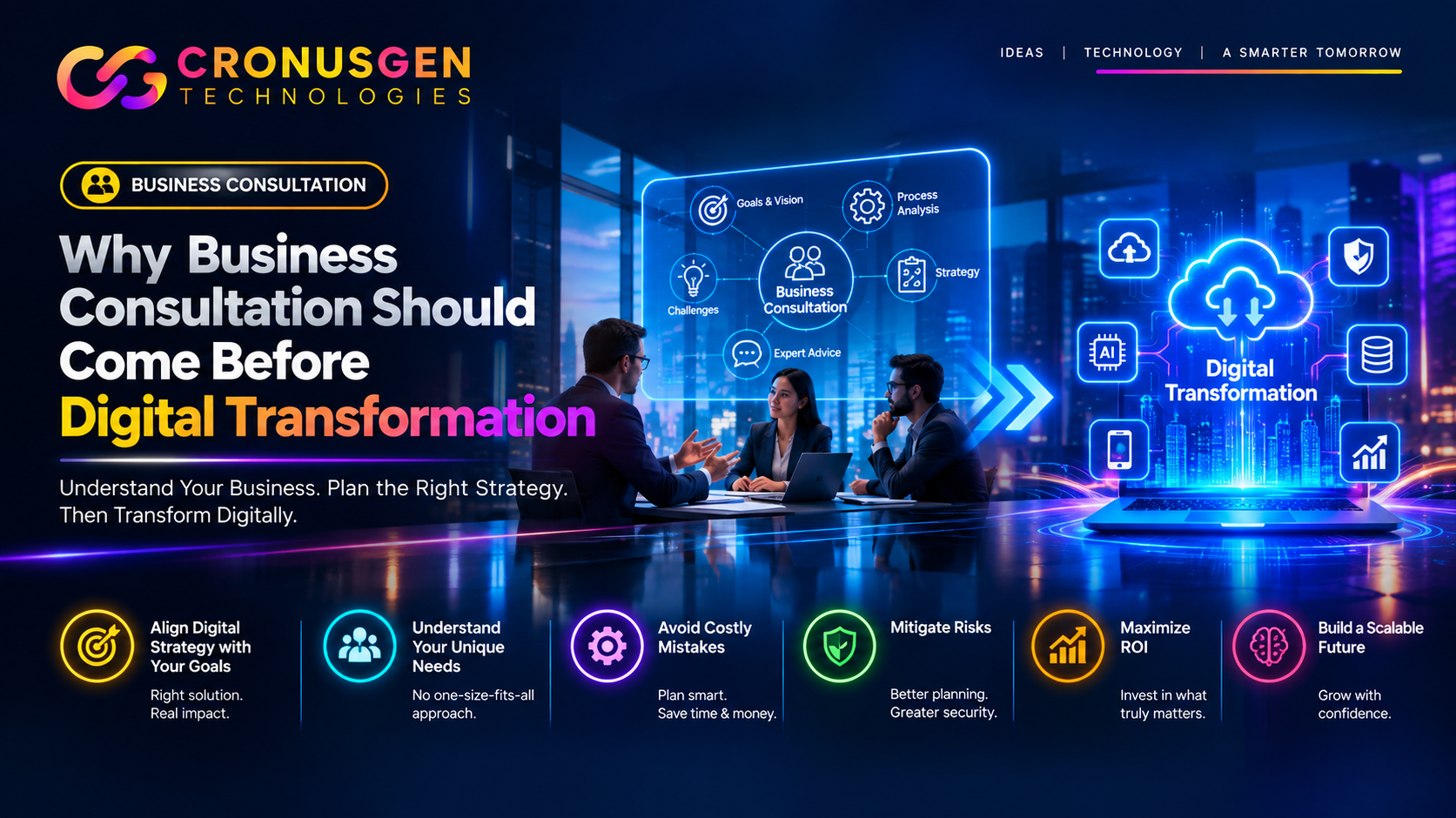
Why Business Consultation Should Come Before Digital Transformation
Digital transformation has become an important part of modern business growth. Companies are adopting cloud platforms, automation, ERP systems, customer management tools, artificial intelligence, analytics, and custom software to improve the way they operate.
However, there is one important question that businesses often overlook:
Are you solving the right problem?
Investing in technology does not automatically improve a business. A company can purchase expensive software, implement automation, or build a custom application and still experience the same operational problems if the underlying business requirements were never properly understood.
This is where business consultation becomes important.
Business consultation helps an organization look at its current operations, identify challenges, understand business objectives, and determine which digital solutions can actually create value.
Instead of starting with:
“What software should we build?”
the better starting point is:
“What problem are we trying to solve?”
What Is Business Consultation?
Business consultation is the process of analyzing a company's current situation, understanding its goals and challenges, and providing structured recommendations for improvement.
A consultation can cover different areas of a business, including:
- Business processes
- Operational workflows
- Customer management
- Employee processes
- Data management
- Inventory management
- Sales and marketing
- Financial workflows
- Reporting
- Software and technology
- Automation opportunities
- System integration
- Digital transformation planning
The goal is not simply to recommend technology.
The goal is to understand how the business works today and how it needs to work in the future.
Once those requirements are clear, technology can be selected or developed around the business rather than forcing the business to adapt to unsuitable technology.
Why Businesses Should Not Start With Software
One of the most common mistakes businesses make is beginning their digital transformation journey by immediately searching for software.
For example, a company may say:
“We need an ERP.”
Another company may say:
“We need a mobile application.”
Another may decide:
“We need automation.”
But these statements do not explain the actual business problem.
Consider a company where employees maintain customer information in spreadsheets, sales information in another system, inventory information somewhere else, and communication through email and messaging applications.
The company may think that it simply needs new software.
But the actual problem could be:
- Duplicate data entry
- Poor communication between departments
- Lack of centralized information
- Manual approval processes
- No real-time reporting
- Unclear responsibilities
- Outdated workflows
- Lack of integration between existing systems
Simply purchasing another software system may not solve these problems.
A proper consultation can identify the root causes before a technology investment is made.
Understanding the Real Business Problem
A good consultation starts by understanding the existing business process.
For example, consider a simple sales process:
Customer Enquiry → Sales Team → Quotation → Approval → Order → Delivery → Invoice → Payment
At first glance, this may appear to be a simple workflow.
But during consultation, several questions need to be asked:
- How does the customer enquiry reach the sales team?
- Where is customer information stored?
- Who prepares the quotation?
- Who approves discounts?
- How long does approval take?
- How is the order communicated to another department?
- How does the inventory team know about the order?
- How is delivery tracked?
- How is the invoice generated?
- How does management know the current status?
- Where are delays occurring?
These questions help reveal the actual operational structure.
The technology solution can then be designed around the answers.
Business Consultation Helps Identify Bottlenecks
A business may have a problem that appears to be related to employees, customers, or sales when the actual problem exists somewhere inside the process.
For example:
Customer enquiry
↓
Manual data entry
↓
Manager approval
↓
Quotation preparation
↓
Email communication
↓
Order processing
↓
Inventory confirmation
↓
Invoice generation
If several of these steps are manual, even a highly capable team can spend significant time completing repetitive work.
Consultation helps identify these bottlenecks and determine which steps can be:
- Simplified
- Standardized
- Automated
- Integrated
- Digitized
- Monitored
This creates a much clearer foundation for digital transformation.
Not Every Business Needs the Same Digital Solution
Every business has different processes.
A manufacturing company may need:
- Inventory management
- Supplier management
- Production tracking
- Purchase management
- Employee management
- Quality control
- Reporting
A service company may need:
- Customer management
- Lead management
- Project management
- Employee allocation
- Invoicing
- Communication
- Service tracking
A growing retail business may require:
- Product management
- Stock management
- Supplier management
- Sales management
- Customer records
- Payments
- Reports
Because the requirements are different, a single solution cannot automatically be considered appropriate for every organization.
Business consultation helps determine what the business actually needs before technology decisions are made.
The Role of Consultation in Digital Transformation
Digital transformation should be treated as a process rather than a single software project.
A practical transformation journey can look like this:
1. Understand
Understand the business, its objectives, customers, employees, processes, and challenges.
2. Analyze
Identify inefficiencies, bottlenecks, duplicated work, data problems, and technology limitations.
3. Define
Convert business challenges into clear and measurable requirements.
4. Plan
Create a digital transformation roadmap based on priorities, resources, budget, and business goals.
5. Choose
Determine whether the organization needs existing software, customization, integration, automation, or a completely custom solution.
6. Implement
Develop or implement the selected solution.
7. Improve
Monitor results and continuously improve the system as the business evolves.
This approach helps prevent businesses from making technology decisions without understanding their long-term requirements.
When Should a Business Consider Consultation?
Business consultation can be particularly useful when an organization experiences signs such as:
Your team is doing too much repetitive work
Employees spend significant time copying information, preparing reports, updating spreadsheets, or performing repetitive administrative tasks.
Information is scattered
Important business information is stored across multiple spreadsheets, applications, emails, documents, or systems.
Departments are disconnected
Sales, operations, finance, inventory, HR, and management may be working with different information.
Management lacks visibility
Decision-makers cannot easily determine what is happening across the business without waiting for manually prepared reports.
Existing software no longer fits
The business has grown, but its existing software cannot support new processes or requirements.
Processes are difficult to track
There is no clear way to determine who completed a task, what stage an order is in, or where a process is currently delayed.
The business is planning major growth
Before expanding operations, companies can evaluate whether their existing processes and technology are capable of supporting that growth.
Consultation Can Prevent Expensive Technology Mistakes
Technology investments can involve significant time, money, and organizational effort.
A poorly planned project can result in:
- Unused features
- Unnecessary software
- Complicated workflows
- Poor employee adoption
- Duplicate systems
- Integration problems
- Unexpected development costs
- Delayed implementation
Consultation provides an opportunity to evaluate these factors before implementation begins.
The objective is not to purchase the most technology.
The objective is to select or create the right technology for the business requirement.
Custom Software vs. Existing Software
Another important question during consultation is whether a business should purchase existing software or develop a custom solution.
Existing software may be appropriate when the business processes closely match the software's capabilities.
Custom software may be considered when:
- The business has unique workflows
- Existing software cannot support important requirements
- Multiple systems need to work together
- The company requires specialized features
- The organization needs greater control over its processes
- The business expects its requirements to evolve
Consultation helps compare these possibilities based on the organization's actual needs rather than simply choosing one approach in advance.
How Cronusgen Approaches Business Consultation
At Cronusgen, business consultation can be approached as the starting point for understanding a company's digital requirements.
Rather than beginning with a predefined technology solution, the process can begin by understanding the organization.
Business Understanding
First, the business objectives and challenges are understood.
Process Analysis
Existing workflows are examined to identify inefficiencies and bottlenecks.
Requirement Identification
The important business requirements are documented and prioritized.
Technology Planning
Potential solutions such as ERP systems, custom software, automation, integrations, dashboards, or other digital tools can then be evaluated.
Solution Development
Once the appropriate approach is established, the required technology can be designed and developed around the business requirements.
Continuous Improvement
As the business grows, its systems and processes can also be reviewed and improved.
This approach connects business strategy with technology implementation.
Business Consultation Is Not Just About Technology
One of the most important aspects of consultation is understanding that technology is only one part of the solution.
A successful digital transformation may require changes to:
- Processes
- Responsibilities
- Communication
- Data management
- Employee workflows
- Reporting
- Customer interactions
- Technology infrastructure
For example, automating a poorly designed process does not necessarily make the process better.
If a business has five unnecessary approval steps, automating all five steps may simply make an inefficient process run faster.
The better approach is:
Understand → Simplify → Improve → Automate
Building a Practical Digital Roadmap
A consultation can also help businesses prioritize their digital transformation.
Instead of attempting to transform everything at once, organizations can divide improvements into stages.
Phase 1 — Immediate Improvements
Address the problems that have the greatest impact on daily operations.
Phase 2 — System Integration
Connect systems and reduce duplicated information.
Phase 3 — Automation
Automate repetitive workflows and administrative tasks.
Phase 4 — Business Intelligence
Introduce dashboards, reports, analytics, and better decision-making tools.
Phase 5 — Continuous Optimization
Review the system and improve it as the organization grows.
This phased approach can make digital transformation more manageable and aligned with business priorities.
The Right Question Is Not “What Technology Do We Need?”
Technology changes rapidly.
New platforms, AI tools, automation systems, applications, and development frameworks continue to appear.
But the business problem remains the starting point.
Instead of asking:
“Which technology should we buy?”
businesses should ask:
“What problem are we trying to solve?”
Then:
“What is causing this problem?”
Then:
“What would an improved process look like?”
And finally:
“Which technology can support that process?”
This sequence creates a much stronger foundation for digital transformation.
Conclusion
Digital transformation should not begin with software. It should begin with understanding the business.
Business consultation provides an opportunity to examine current processes, identify challenges, understand business goals, and create a practical roadmap before technology decisions are made.
Whether the final solution involves an ERP system, custom software, automation, system integration, dashboards, or another digital platform, the technology should support the way the business needs to operate.
At Cronusgen, the objective is to connect business challenges with practical digital solutions—helping organizations understand what they need before deciding how to build or implement it.
The right technology starts with the right business understanding.